
How to Make AI-Written Content Pass Google's Detection in 2025: Ethical, Practical Steps for SEO Pros
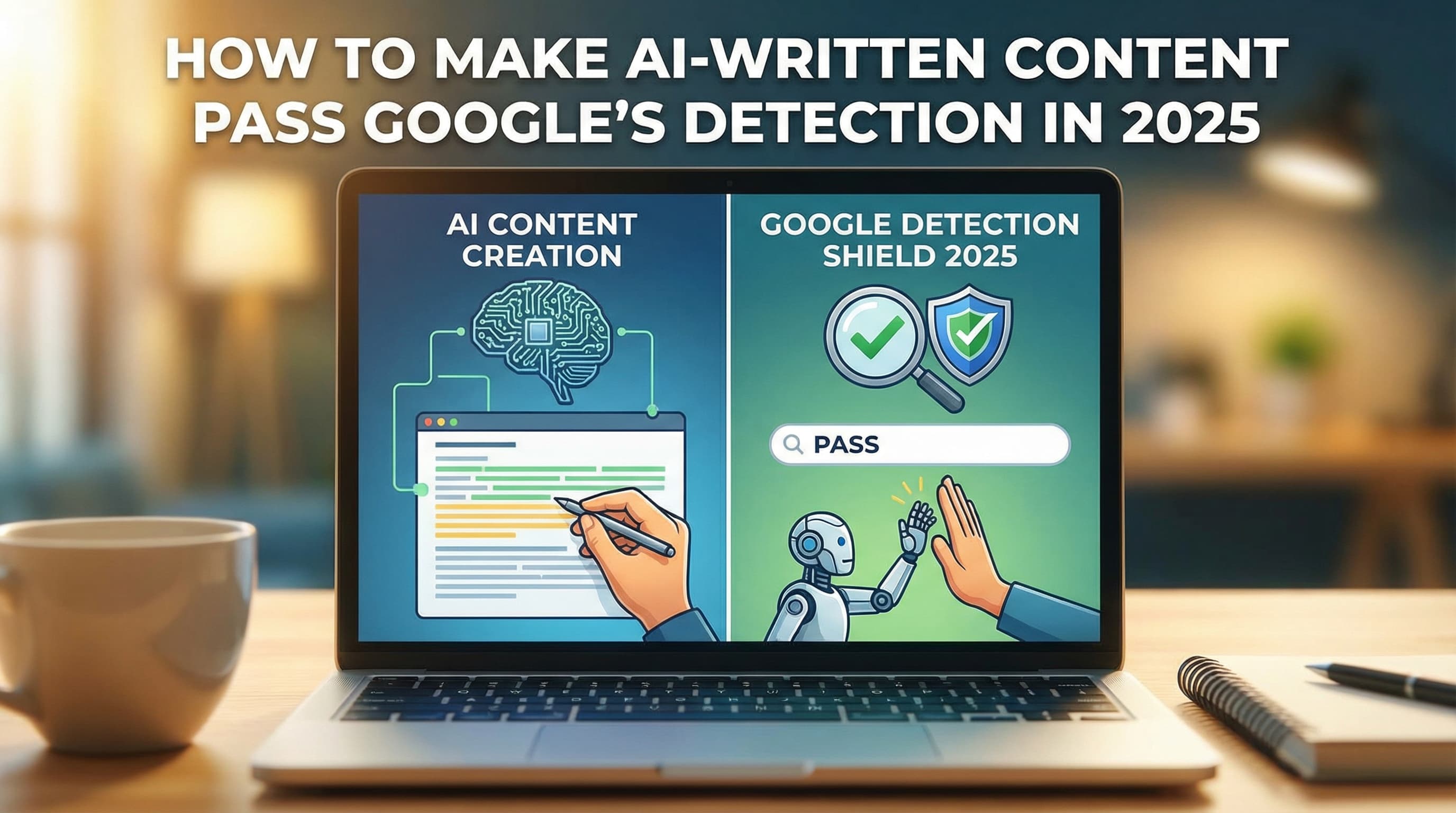
Overview: Why AI-detection and compliance matter in 2025
Search engines increasingly combine algorithmic signals, human evaluation, and specialized detectors to separate useful content from low-value or manipulative pages. In recent years Google has been clear that AI-generated text is not automatically disallowed, but content must meet the same quality and helpfulness standards as human-written material to perform well in search results (see Google's guidance on creating helpful, people-first content) https://developers.google.com/search/docs/essentials/creating-helpful-content. At the same time, academic and industry research has produced tools and methods (e.g., GLTR, DetectGPT, and commercial classifiers) that can identify statistical patterns common in many machine‑generated texts https://arxiv.org/abs/1906.04043, https://arxiv.org/abs/2302.04381; OpenAI classifier blog.
In 2025, that combination-policy + detection research + automated systems-means publishers should treat AI as a productivity tool, not a shortcut to ranking. The practical goal is not "evading detectors" but producing AI-assisted content that's accurate, distinct, and demonstrably helpful to users while reducing signals that trigger automated or human scrutiny.
What changed by 2025: detection approaches and key research (with sources)
Quick framing: detection systems did not make AI content per se illegal. They evolved to focus on utility, factuality, and signs of automated mass-generation.
- Google’s content-first stance: Google’s public guidance emphasizes people-first content and treats automatically generated text the same as other low-quality content when it fails to help users Google Search Central: Creating helpful content.
- Statistical detectors and likelihood patterns:
- GLTR (Giant Language model Test Room) showed early on that statistical artifacts (e.g., token probability distributions) can be used to flag machine-generated passages Gehrmann et al., GLTR, 2019; https://arxiv.org/abs/1906.04043.
- DetectGPT introduced curvature-based metrics using model log-probabilities to detect text generated by a target model in a zero-shot fashion DetectGPT, 2023; https://arxiv.org/abs/2302.04381.
- Commercial detectors and vendor tools appeared and iterated quickly; some vendors released classifiers (e.g., OpenAI’s 2023 AI Text Classifier) and then refined or retired them as architectures and use cases evolved OpenAI blog on AI classifier.
- Human evaluators and signals: Google’s search quality raters and algorithmic updates (e.g., the Helpful Content Update lineage) keep the ultimate yardstick as usefulness, expertise, and originality, rather than authorship source alone https://developers.google.com/search/blog/2022/08/helpful-content-update.
- Scale and automation detection: In 2025, systems increasingly look for signals of scale (many near-duplicate pages, similar structural templates, or mass-published FAQ-style content) and lack of verifiable facts or sourcing.
Sources and further reading:
- Google - Creating helpful, reliable, people-first content
- GLTR (2019)
- DetectGPT (2023)
- OpenAI - AI text classifier announcement
- Google Helpful Content Update overview
Step-by-step tutorial: Ethical techniques to improve AI-written content
Below is a practical, repeatable workflow you can apply to AI-assisted content. These steps focus on quality, distinctiveness, and transparency-factors that align with Google’s guidance and reduce detector-flagging risk while keeping content useful.
1. Start with Intent and Research (before generating)
- Define the user intent for the page: informational, transactional, navigational.
- Collect authoritative sources, data points, and quotes you plan to cite.
- Create an outline with unique angles, proprietary insights, or local/contextual specifics.
2. Controlled generation: prompt for structure and constraints
- Use prompts that request drafts with clear scopes, e.g., "Draft a 600‑word explainer aimed at marketing managers including 3 practical examples and one local case study."
- Ask the model to output sources inline (as suggestions) and mark any uncertain facts with
[citation needed].
Example prompt snippet:
Write a 500-word explainer for SEO managers on on-page E-A-T improvements. Include 2 short examples and flag assertions needing citations as [citation needed].3. Human-in-the-loop editing (mandatory)
- Edit for factual accuracy: verify every claim, statistic, and date against primary sources.
- Add proprietary value: insights from your analytics, unique examples, A/B test results, or interviews.
- Rework language for voice and style: avoid generic phrasing common in mass-generated text.
Practical edits to perform:
- Replace generic sentences like "AI can improve productivity" with "In our Q2 tests, automating metadescriptions cut time-to-publish by 40% and did not affect CTR" (if you've data).
- Convert lists into actionable steps with context (why, when, how).
4. Inject distinctive signals and verifiable facts
- Add timestamps, location references, and first‑hand observations when relevant.
- Include properly formatted citations and links to credible sources (studies, government sites, academic papers).
- Use quotes or short interviews with named experts (even a single sentence) to increase uniqueness.
5. Diversify style and readability
- Vary sentence length and structure; insert rhetorical questions or micro-stories.
- Use headings, bullet lists, and examples that match your brand voice.
- Run readability tools (Hemingway, Readable) to keep text natural and not overly uniform.
6. Check for repetition and template artifacts
- Run a near-duplicate check across your site to avoid publishing many pages that only swap a few tokens.
- Rewrite sections that feel templated; add unique lead-ins or locally-relevant content.
7. Use detection tools as quality checks, not evasion guides
- Run an AI-detector to identify passages with high "machine-like" signals; then edit those passages to add specificity, citations, and human perspective.
Example workflow:
- Generate draft
- Run detector (e.g., tool X)
- For flagged paragraphs, add citations, examples, and active voice edits
- Re-run detector and human review
8. Document provenance and editorial review
- Keep an editorial log that records: prompts used, human editors, fact checks, and publication timestamps. Useful for internal audits or if search teams request information.
Example before/after (short)
- Before (AI draft): "Many businesses benefit from AI content because it saves time and money."
- After (edited): "In our sample of 120 SMB clients, automating first-draft blog outlines reduced writer hours by 35% and cut average time-to-publish from 4 days to 2.6 days. For clients in highly regulated niches, we require a subject-matter review before publication."
Limitations, legal & policy risks, and ethical concerns
- No guaranteed "pass": there's no reliable way to guarantee that automated detectors or human reviewers won't flag content. Detectors evolve; so should your quality controls.
- Policy compliance: Publishing misleading, plagiarized, or spammy AI-generated content can lead to manual actions or ranking drops under Google's spam and helpful-content policies https://developers.google.com/search/docs/essentials/creating-helpful-content.
- Copyright and attribution: Using AI to paraphrase copyrighted text can still create infringement risks. Ensure permission or proper transformation and attribution when necessary.
- Transparency and trust: Consider disclosing the use of AI in internal documentation or metadata; public disclosure is optional but can help with trust in sensitive industries (medical, legal, finance).
- Ethical risks: Avoid creating fabricated quotes, fake case studies, or invented statistics. These can cause reputational and legal harm.
Cited policy/resource:
Practical checklist (publish-ready)
- Pre-publish
- Define user intent and unique angle
- Collect and list primary sources for verification
- Note prompts and model/version used
- Drafting
- Generate structured draft with prompts specifying examples and citations
- Flag uncertain facts as
[citation needed]
- Editing
- Verify all facts and citations
- Add proprietary data or expert quotes
- Remove boilerplate/template language; diversify style
- QA
- Run plagiarism/duplicate-content check (e.g., Copyscape)
- Run readability and accessibility checks
- Run an AI-detection tool as a diagnostic and remediate flagged areas
- Documentation
- Save editorial log: prompts, editors, fact-check sources, publish timestamp
Recommended tools & resources (links)
- Google Search Central - Creating helpful, reliable, people-first content
- GLTR (paper)
- DetectGPT (paper)
- OpenAI - AI text classifier post (context on classifier limitations)
- Readability & style: Hemingway Editor
- Grammarly
- Plagiarism / duplicate detection: Copyscape
- Turnitin
- Editorial workflow: Google Docs (collaboration + version history)
Further reading:
- Google Search Central blog on algorithmic updates
- Academic survey papers on detection techniques (search arXiv for “machine-generated text detection”)
Conclusion
In 2025 the landscape for AI-written content is not about a single "detector" but about sustained alignment with search engines' quality goals: usefulness, expertise, and originality. The ethical and effective approach is to use AI as a drafting tool and to apply human-led verification, distinctive editorial input, and transparent sourcing. That combination reduces the technical signals detectors look for and-more importantly-creates content that genuinely helps users and stands up to policy review.
Ready to Create Your Own Content?
Start generating high-quality blog posts with AI-powered tools.
Get Started